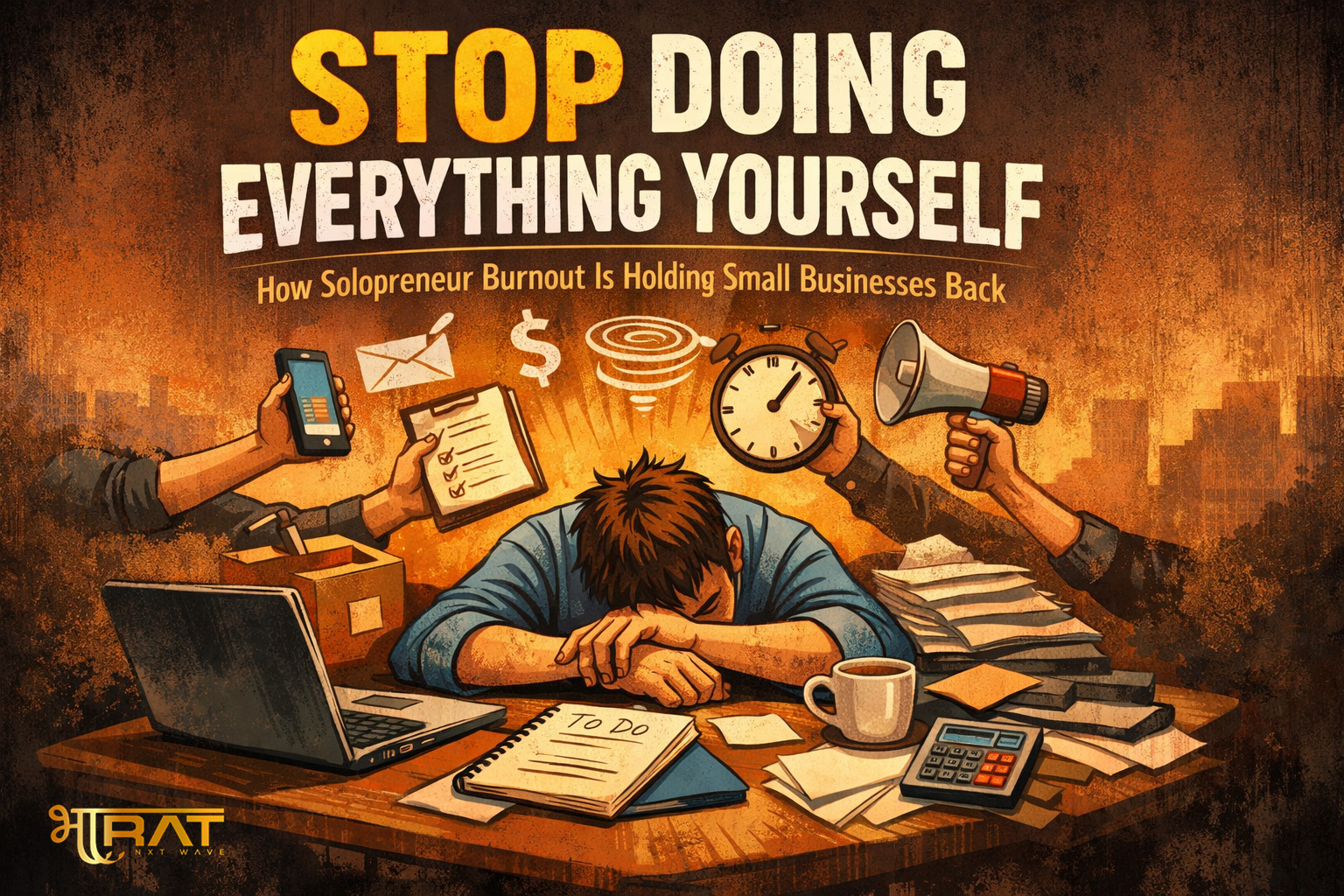
Many small business owners start their journey believing they must wear every hat — CEO, marketer, accountant, content creator, customer support, and operations manager. While this hands-on approach may work in the early startup stage, it often leads to solopreneur burnout, reduced productivity, and stalled business growth.
In today’s competitive small business ecosystem, especially in markets driven by digital marketing, automation tools, and online branding, trying to manage everything alone can quietly sabotage your success. Instead of scaling your startup, you become trapped in daily operational tasks.
This article explores how solopreneur burnout impacts entrepreneurship, business scalability, profitability, and leadership growth, and how strategic delegation and systems can help you build a sustainable business model.

Solopreneur burnout is a state of chronic stress, exhaustion, and reduced performance caused by managing every aspect of a business alone. Unlike corporate burnout, this type affects founders who lack team support and structured workflows.
In the world of MSMEs, startups, and digital businesses, founders often believe outsourcing increases expenses. However, research from platforms like Harvard Business Review highlights that founder overload reduces innovation and decision-making efficiency.
When you are stuck managing social media marketing, SEO strategy, accounting compliance, lead generation, and customer service, you lose focus on strategic growth.
Fear of losing control
Budget constraints
Lack of trust in outsourcing
Perfectionism
Early-stage bootstrap mindset
While bootstrapping is common in entrepreneurship, sustainable business development requires moving beyond survival mode.
According to data from the Small Business Administration (SBA), businesses that delegate effectively are more likely to scale within the first five years.
When founders spend hours on administrative work instead of strategy, business expansion slows down. Time spent designing Canva posts could be used building partnerships or improving revenue streams.
Growth activities include:
Market research
Strategic planning
Customer acquisition strategy
Business automation
Brand positioning
If you’re stuck in operations, you cannot focus on scalability.
Productivity tools like CRM systems, project management software, and AI automation exist to optimize workflow. However, many small business owners underutilize them.
Solopreneur burnout leads to:
Decision fatigue
Missed deadlines
Inconsistent marketing
Poor customer experience
Over time, operational inefficiencies impact profit margins and brand reputation.
Entrepreneurship thrives on innovation. When you are exhausted, creativity declines.
High-growth startups prioritize:
Research & development
Customer feedback analysis
Product optimization
Competitive positioning
But burnout forces founders into reactive mode instead of visionary leadership.
Many founders believe:
“No one can do it better than me.”
This control mindset blocks leadership development. Modern business psychology emphasizes delegation as a leadership strength, not weakness.
Developing a growth mindset in entrepreneurship allows founders to build systems instead of controlling every task.
Delegation feels risky because:
You fear mistakes.
You fear financial loss.
You fear brand inconsistency.
But failing to delegate creates long-term revenue loss.
In competitive industries like digital services, content marketing, ecommerce, and consulting, speed matters more than perfection.
Working 12+ hours daily
Constant mental exhaustion
Delayed strategic decisions
No time for skill development
Declining revenue growth
If your small business revenue has plateaued despite increased effort, burnout may be the hidden cause.
A scalable business depends on:
SOPs (Standard Operating Procedures)
Automation tools
Delegated workflows
Repeatable processes
If your business depends entirely on you, it is not scalable.
For example:
If you manage every client onboarding call, your revenue is capped by your availability.
Many small business owners hit an income ceiling because they:
Trade time for money
Avoid hiring freelancers
Don’t build operational systems
Solopreneur burnout prevents long-term wealth creation because income remains linked to effort.
Administrative tasks
Bookkeeping and compliance
Social media scheduling
Graphic design
Customer support
Using platforms like Upwork, Fiverr, or local agencies can reduce workload without increasing fixed costs.
Delegation improves:
Operational efficiency
Leadership focus
Revenue growth
Strategic thinking
Outsourcing works best for:
Content marketing
SEO optimization
Web development
Ad campaign management
Hiring full-time employees works when:
Revenue is stable
Processes are defined
Growth projections are clear
The key is structured delegation, not random outsourcing.
CRM systems (HubSpot, Zoho)
Email marketing automation
Accounting software
Project management tools
AI content tools
Automation improves workflow efficiency and reduces manual errors.
In digital entrepreneurship, automation is a competitive advantage.
To overcome solopreneur burnout, you must shift identity:
From:
“I do everything.”
To:
“I build systems.”
High-performing founders focus on:
Vision
Strategy
Partnerships
Revenue optimization
Market expansion
Your role should evolve as your startup grows.
When you delegate:
Revenue increases
Costs stabilize
Customer retention improves
Brand consistency strengthens
Marketing ROI improves
Time becomes available for:
Business networking
Investor meetings
Product innovation
Expansion strategy
This directly impacts profitability.
A sustainable business requires:
Process documentation
Team collaboration
Financial planning
Risk management
Long-term strategic planning
Small business sustainability depends on structured leadership, not heroic effort.
An ecommerce founder handling:
Ads
Customer emails
Inventory
Accounting
Social media
Revenue plateaued at $8,000/month.
After:
Hiring a virtual assistant
Outsourcing Facebook Ads
Automating email sequences
Revenue scaled to $25,000/month in 8 months.
The difference? Reduced solopreneur burnout and improved strategic focus.
Ignoring burnout can lead to:
Business shutdown
Health issues
Financial instability
Loss of competitive edge
Entrepreneurial sustainability requires energy management as much as financial management.
Track weekly activities.
Highlight repetitive tasks.
Use digital tools.
Start small.
Sales, partnerships, product development.
If you’re managing your own SEO, content marketing, and analytics without expertise, rankings suffer.
Professional SEO strategy improves:
Organic traffic
Keyword ranking
Domain authority
Lead generation
Conversion rate
Delegating technical SEO helps scale digital visibility.
Solopreneur burnout is not a badge of honor — it’s a growth blocker.
Small business success today requires:
Strategic delegation
Automation
Leadership mindset
System-driven operations
Entrepreneurship is about building an asset, not creating another job for yourself.
If you want sustainable growth, improved profitability, and long-term scalability, the solution is simple:
Stop doing everything alone.
Start building systems.