Choosing the right legal structure is one of the most critical—and most misunderstood—decisions founders make. In India’s fast-moving startup ecosystem, many entrepreneurs rush to register a business without fully understanding the long-term implications of their choice. As a result, the wrong company structure for startups in India silently becomes one of the most expensive mistakes founders make over time.
This blog breaks down, in detail, how choosing the wrong company structure affects startups over a five-year horizon, including compliance costs, taxation inefficiencies, funding roadblocks, operational limitations, and forced restructuring expenses.
Many founders treat company registration as a checkbox—something to be completed quickly so they can start operating. However, the legal structure of a startup directly influences:
Tax liability
Compliance burden
Fundraising eligibility
Ownership flexibility
Exit options
Founder liability
Ignoring these factors early almost always leads to structural inefficiencies that compound year after year.
A wrong company structure does not necessarily mean illegal—it means misaligned.
Examples include:
Registering a proprietorship when external funding is planned
Choosing a partnership instead of LLP for risk-heavy operations
Operating as an LLP while seeking venture capital
Registering a Private Limited company too early without scale readiness
Each of these decisions carries hidden costs that only become visible with time.
Before diving into the cost analysis, let’s briefly understand the structures most startups choose from:
Proprietorship
Partnership Firm
Limited Liability Partnership (LLP)
Private Limited Company
Section 8 Company (non-profit use cases)
The problem arises not from the structure itself—but from choosing one without a 5-year vision.
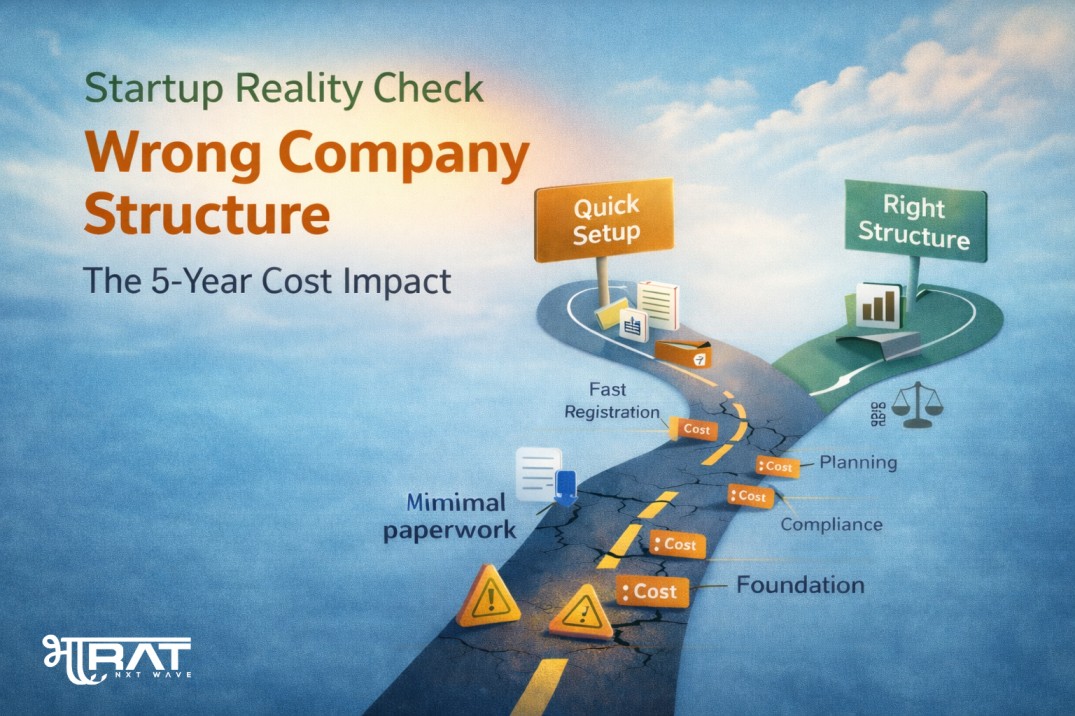
In the first year, founders often believe they’ve made a “smart” decision by choosing a simpler structure.
A founder registers a proprietorship or partnership because:
Low registration cost
Minimal compliance
Faster setup
At this stage, the wrong company structure for startups in India feels efficient rather than risky.
Unlimited personal liability
No clear ownership documentation
No eligibility for startup benefits
Difficulty opening structured banking facilities
The risk is invisible—but already active.
As revenue grows, regulatory systems begin paying attention.
GST scrutiny increases
Income tax assessments begin
Banking KYC becomes stricter
Many founders realize their current structure is tax-inefficient and poorly documented.
Startups facing such issues often seek professional company registration and compliance services to reassess whether their current structure still aligns with growth plans and regulatory expectations.
By year three, startups usually explore:
Angel funding
Government grants
MSME loans
Strategic partnerships
This is where the wrong company structure for startups in India becomes a serious blocker.
No shareholding framework
No ESOP capability
Weak governance
Poor audit readiness
Many funding opportunities explicitly exclude proprietorships and partnerships.
According to the Startup India recognition framework, only eligible legal entities such as Private Limited companies and LLPs can access many government-backed startup benefits and incentives.
This is the most expensive phase.
Founders now realize they must convert or restructure the business.
Conversion expenses
Stamp duty
Legal fees
Capital gains implications
Compliance clean-up
Business downtime
At this stage, the wrong decision made in Year 1 becomes a six-figure problem.
Many founders rely on expert business restructuring advisory services at this stage to minimize damage and transition into a compliant, fundable structure without disrupting operations.
Even after restructuring, damage lingers.
Broken compliance history
Delayed funding timelines
Reduced valuation
Increased investor skepticism
Investors often discount startups that have undergone messy structural changes—even if the business fundamentals are strong.
| Cost Area | Right Structure | Wrong Structure |
|---|---|---|
| Compliance | Predictable | Penalty-driven |
| Tax Efficiency | Optimized | Excessive |
| Fundraising | Smooth | Restricted |
| Restructuring | Nil | High |
| Founder Stress | Low | Extremely High |
The numbers may vary, but the conclusion remains the same.
Despite widespread information, founders still choose the wrong structure due to:
Short-term thinking
Bad advice from peers
Cost-saving mindset
Lack of regulatory understanding
This is why the wrong company structure for startups in India remains one of the most common yet preventable errors.
The Ministry of Corporate Affairs (MCA) clearly outlines compliance, governance, and reporting obligations for different business structures—yet many startups ignore these guidelines until issues arise.
Choosing the right structure from day one enables:
Easier capital infusion
Cleaner audits
Stronger governance
Better exit readiness
The right structure does not slow growth—it supports sustainable growth.
Startups planning long-term scale often consult startup advisory and growth planning services to align their legal structure with funding, taxation, and expansion goals from the beginning.
Many founders debate between LLP and Private Limited companies.
Bootstrapped operations
Service-based businesses
No equity dilution planned
External funding expected
ESOPs required
High scalability planned
Choosing incorrectly leads directly to the wrong company structure for startups in India.
The Reserve Bank of India (RBI) lending framework often favors structured corporate entities with transparent governance and compliance histories when assessing business creditworthiness.
Investors asking you to convert before funding
Banks rejecting loan applications
Frequent compliance notices
Tax inefficiencies
Difficulty onboarding partners
If you see these signs, action is needed immediately.
Before registering, ask:
Will I raise external funding?
Do I need ESOPs?
What is my 5-year vision?
What compliance burden can I handle?
How important is limited liability?
Answering these honestly prevents costly mistakes.
Never choose a company structure based on:
Current revenue
Current cost savings
Peer advice
Always choose based on where the business should be in 5 years.
The wrong company structure for startups in India is not a legal error—it is a strategic failure.
Founders who treat structure as infrastructure build businesses that:
Scale faster
Raise capital easier
Attract better partners
Survive regulatory scrutiny
At BharatNXT Wave, we help founders choose structures that support growth—not sabotage it.