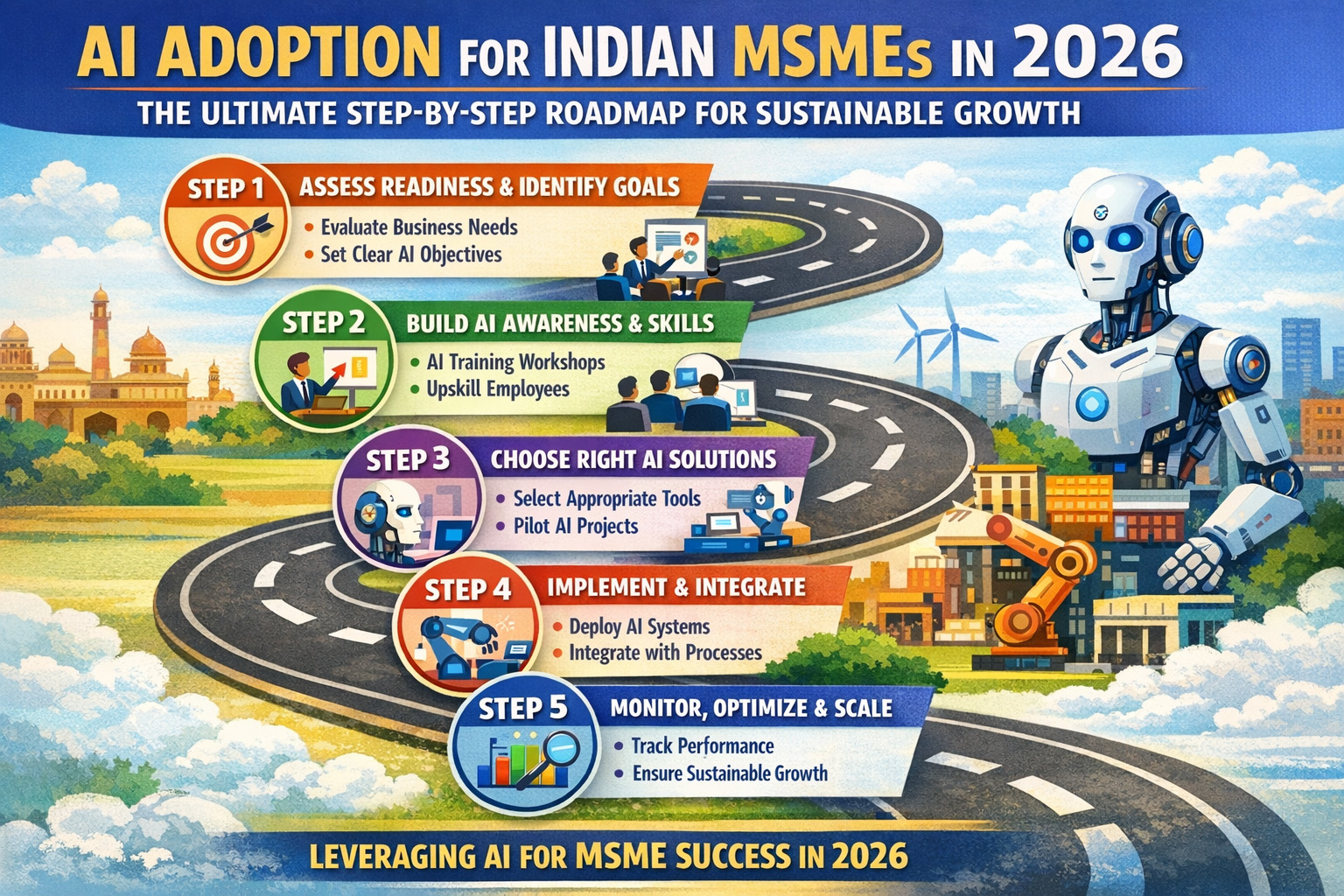
In 2026, AI Adoption for Indian MSMEs will no longer be a luxury—it will be a competitive necessity. With India emerging as one of the fastest-growing digital economies, Micro, Small, and Medium Enterprises (MSMEs) must align with emerging technologies like artificial intelligence, machine learning, automation, and data analytics to stay competitive.
According to the Ministry of Micro, Small and Medium Enterprises, MSMEs contribute nearly 30% to India’s GDP and employ over 110 million people. As digital transformation accelerates, AI-powered solutions are becoming more affordable, scalable, and accessible—even for small businesses.
This practical roadmap will guide Indian MSMEs step-by-step toward successful AI integration while maintaining cost efficiency, regulatory compliance, and long-term sustainability.
AI is transforming industries globally—from manufacturing and retail to logistics and fintech. In India, initiatives like Digital India and Startup India are accelerating digital transformation across sectors.
For Indian MSMEs, AI adoption offers:
Increased operational efficiency
Predictive analytics for smarter decision-making
Automation of repetitive tasks
Enhanced customer experience
Cost optimization
Improved supply chain management
In a competitive market influenced by globalization and e-commerce expansion, AI-driven business models can significantly improve profitability and resilience.
India has over 63 million MSMEs operating across manufacturing, services, retail, and agriculture-related sectors. However, digital maturity varies widely.
| Area | Current Status | AI Opportunity |
|---|---|---|
| Data Usage | Mostly manual records | Data analytics & predictive insights |
| Marketing | Traditional & social media | AI-powered digital marketing |
| Operations | Manual workflows | Robotic Process Automation (RPA) |
| Customer Service | Phone/email-based | AI chatbots & CRM automation |
Many MSMEs already use accounting software, GST compliance tools, and e-commerce platforms. The next step is integrating artificial intelligence into these systems.
Before implementing AI, businesses must evaluate their digital maturity.
Are your processes digitized?
Do you collect structured data?
Is your ERP/CRM system cloud-enabled?
Is your IT infrastructure scalable?
Without clean, structured data, AI systems cannot generate meaningful insights. Digital transformation must precede AI implementation.
Digital transformation strategy
MSME technology upgrade
Business automation in India
AI adoption should solve real business problems—not follow trends.
Inventory forecasting
Demand prediction
Customer segmentation
Fraud detection
Smart pricing strategies
Example: A retail MSME using AI-based demand forecasting can reduce excess inventory by 20–30%.
| Goal | Example |
|---|---|
| Specific | Reduce customer churn |
| Measurable | Improve retention by 15% |
| Achievable | Deploy AI CRM |
| Relevant | Boost recurring revenue |
| Time-bound | Within 6 months |
Clear objectives improve ROI measurement and resource allocation.
Data is the backbone of AI adoption.
Clean historical sales data
Customer behavior analytics
Financial transaction records
Supply chain metrics
Cloud platforms reduce capital expenditure and allow scalable AI deployment. Global providers and Indian SaaS startups offer affordable AI-as-a-service solutions.
Data privacy compliance
Secure storage
Regular backups
Access control policies
Strong data governance ensures regulatory compliance and cybersecurity resilience.
Not all AI solutions fit every MSME.
| Function | AI Solution Type |
|---|---|
| Marketing | AI-powered marketing automation |
| Sales | Predictive CRM |
| Operations | RPA tools |
| Finance | AI accounting & fraud detection |
| HR | AI recruitment screening |
Check scalability
Evaluate pricing model
Assess integration capability
Review support and training
Collaborating with Indian AI startups can reduce implementation costs and improve localization.
Technology adoption fails without human alignment.
AI awareness workshops
Online certification programs
Internal innovation teams
Cross-functional collaboration
India’s skill ecosystem is supported by programs under Skill India, which encourages workforce modernization.
Building an AI-ready workforce ensures long-term digital transformation success.
Instead of large-scale deployment, begin small.
Chatbot for customer support
AI inventory management module
Automated invoice processing
Lower financial risk
Faster feedback loops
Data-driven refinement
Employee confidence building
Pilot programs validate feasibility before scaling across departments.
With AI integration comes responsibility.
Data Protection Bill (India)
Industry-specific regulations
Financial reporting standards
Cybersecurity threats increase with digitization. MSMEs must invest in:
Endpoint security
Multi-factor authentication
Regular penetration testing
Ethical AI includes transparency, bias reduction, and accountability.
AI adoption must deliver measurable value.
| Metric | Measurement |
|---|---|
| Revenue Growth | % Increase |
| Cost Savings | Operational reduction |
| Productivity | Output per employee |
| Customer Satisfaction | NPS score |
Scaling AI without performance tracking can drain resources. Data-driven scaling ensures sustainable growth.
Indian MSMEs can leverage:
Credit Guarantee Scheme
Technology Upgradation Funds
Digital MSME Scheme
AI-focused startup incubators
Policies under the NITI Aayog promote AI innovation in India’s economic framework.
Government support reduces financial burden and accelerates AI implementation.
Predictive maintenance
Quality inspection automation
Supply chain optimization
Personalized marketing
Dynamic pricing
Inventory forecasting
Fraud detection
Automated customer onboarding
Credit scoring algorithms
Sector-specific AI integration improves competitiveness in both domestic and global markets.
Solution: SaaS-based AI tools and subscription models.
Solution: Partnerships with edtech platforms and consultants.
Solution: Leadership-driven digital transformation strategy.
Solution: Centralized ERP systems and cloud integration.
Overcoming these barriers is essential for successful AI transformation.
By 2026 and beyond:
AI will become embedded in daily operations
Hyperautomation will reduce manual workload
MSMEs will compete globally through digital platforms
AI-driven export growth will expand
India’s growing digital infrastructure and startup ecosystem will fuel affordable AI innovation.
Early adopters of AI adoption strategies will gain competitive advantage.
AI Adoption for Indian MSMEs is not about replacing human effort—it is about enhancing productivity, innovation, and profitability. With structured planning, workforce training, data readiness, and strategic implementation, MSMEs can successfully integrate AI into their business models.
The journey requires:
Digital readiness assessment
Clear goal setting
Robust data infrastructure
Smart vendor selection
Workforce upskilling
Pilot testing
Compliance and cybersecurity
ROI measurement and scaling
Indian MSMEs stand at the threshold of a transformative decade. By embracing artificial intelligence strategically in 2026, they can build resilient, scalable, and globally competitive enterprises.