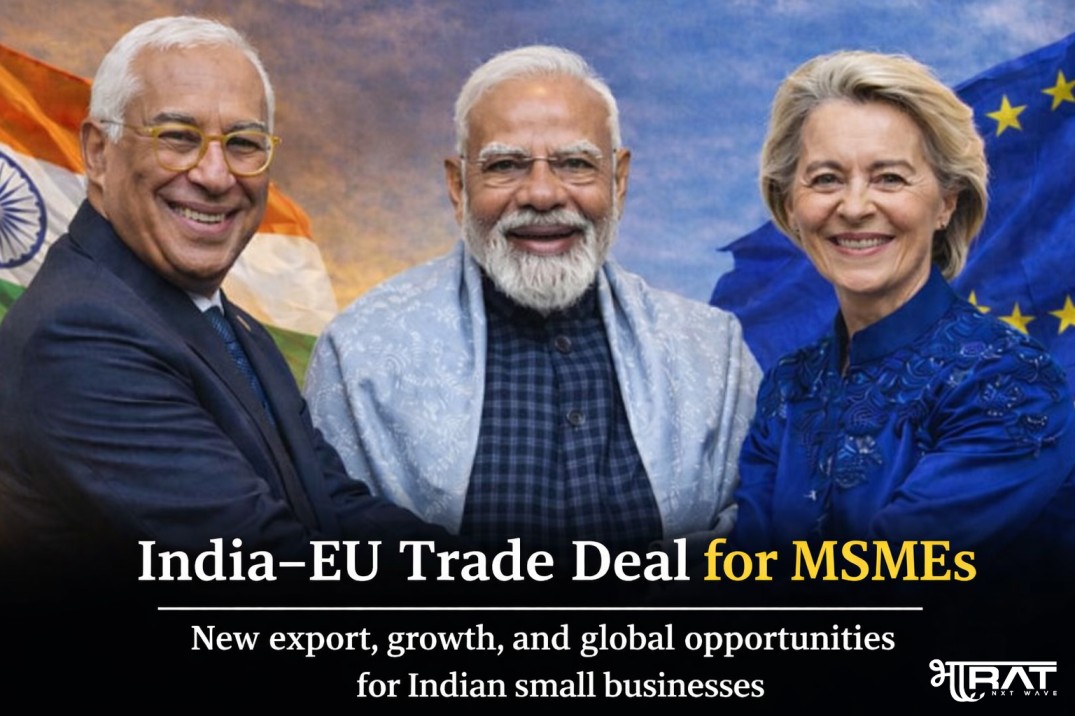
The India–EU trade deal for MSMEs marks a historic turning point for India’s small business ecosystem. Finalized in January 2026, the India–EU Free Trade Agreement (FTA) is not just another international policy document—it is a practical growth tool for India’s 42 million Micro, Small, and Medium Enterprises (MSMEs). For decades, Indian MSMEs have faced challenges such as high export duties, complex compliance procedures, rising input costs, and limited access to global markets. This agreement directly addresses these pain points.
The India–EU trade deal for MSMEs focuses on sectors dominated by small businesses, ensuring that benefits do not remain limited to large corporations. With reduced tariffs, simplified trade rules, improved market access, and strong sustainability support, the FTA creates a rare triple advantage: lower costs, higher profitability, and easier business operations. This blog explores in detail how the India–EU trade deal is helping MSMEs in India unlock new growth opportunities.
Businesses looking to strengthen their MSME export readiness can benefit from structured guidance on IEC registration, export documentation, and EU trade compliance.
The India–EU Free Trade Agreement is a comprehensive economic partnership between India and the European Union—one of the world’s largest consumer markets. The agreement covers trade in goods, services, investment, digital trade, sustainability, and professional mobility. What makes it unique is its explicit MSME-friendly framework.
The India–EU trade deal for MSMEs includes special provisions such as self-certification, SME contact points, simplified customs procedures, and preferential access for MSME-heavy sectors. For Indian entrepreneurs, exporters, and manufacturers, this deal reduces long-standing structural barriers that made exporting to Europe expensive and complicated.
More details about the scope and structure of the India–EU Free Trade Agreement are available through official European Union trade policy resources.
One of the most powerful features of the India–EU trade deal for MSMEs is the elimination of tariffs on over 99% of Indian exports to the European Union. For small businesses operating on thin margins, even a 5–10% duty can determine whether an export order is viable.
Under the new FTA, MSME-dominated sectors such as textiles, apparel, leather, footwear, handicrafts, marine products, gems, jewellery, and engineering goods now enjoy zero-duty access to the EU market. This directly improves price competitiveness against exporters from China, Vietnam, and other Asian economies.
From an SEO and business standpoint, terms like zero tariff exports, India EU trade agreement impact, and MSME profitability through FTA naturally align with this transformation. MSMEs can either lower prices to win larger orders or maintain prices and increase margins—both outcomes strengthen financial stability.
Textile and garment MSMEs form the backbone of India’s export economy. Earlier, EU duties of around 12% made Indian products less competitive compared to Bangladesh. With the India–EU trade deal for MSMEs, tariffs drop to zero, placing Indian exporters on equal footing.
Clusters like Tirupur, Ludhiana, and Surat are expected to see higher order volumes, better buyer retention, and increased foreign exchange earnings. Keywords such as textile MSME exports, India EU apparel trade, and MSME garment industry growth fit naturally into this narrative.
Leather and footwear MSMEs from Agra and Kanpur earlier faced EU tariffs as high as 17%. Their removal significantly boosts margins. Similarly, handicraft exporters from Jaipur and Moradabad gain an instant margin increase, making Indian craftsmanship more attractive to European buyers.
The India–EU trade deal for MSMEs thus preserves traditional industries while making them globally competitive—an important internal keyword alignment with Make in India, artisan exports, and traditional MSME clusters.
The benefits of the India–EU FTA are not limited to exports. MSMEs also gain from reduced tariffs on European machinery, equipment, chemicals, and raw materials. Import duties on specialized machinery—earlier as high as 44%—are now close to zero.
For MSMEs in food processing, pharmaceuticals, textiles, and engineering, this means easier access to advanced European technology at affordable prices. Similarly, the removal of duties on specialized chemicals and plastics reduces production costs for thousands of small manufacturing units.
Keywords such as MSME manufacturing cost reduction, import duty benefits under FTA, and technology upgrade for MSMEs integrate naturally when discussing this cost advantage.
One of the most overlooked but impactful aspects of the India–EU trade deal for MSMEs is its focus on simplifying trade procedures. Small businesses often lack dedicated legal and compliance teams, making complex international trade documentation a major hurdle.
Simplified procedures under the FTA make export compliance for MSMEs more accessible, especially when supported by professional assistance in registrations and regulatory approvals.
MSMEs can now issue their own Statement on Origin, eliminating dependence on time-consuming government certifications. This change significantly reduces export delays and administrative costs.
Dedicated MSME help desks in India and the EU provide direct channels for resolving trade-related issues. Whether it is a shipment stuck at a European port or a documentation query, MSMEs now have structured legal support.
The agreement allows electronic signatures and paperless customs processes. This directly aligns with keywords like ease of doing business for MSMEs, digital trade India EU, and simplified export compliance.
The India–EU trade deal for MSMEs goes beyond exports—it integrates Indian small businesses into European supply chains. European brands in fashion, automotive, electronics, and engineering are actively diversifying sourcing away from China.
This creates opportunities for Indian MSME clusters to supply components, fabrics, and intermediate goods to EU-based manufacturers. Participation in global value chains ensures long-term contracts, stable revenues, and technology transfer.
For service-based MSMEs, the agreement supports Mode 4 mobility, making it easier for Indian professionals to work on short-term projects in the EU. Keywords such as global value chains, India EU services trade, and MSME international expansion strengthen content relevance.
Sustainability compliance has been a major concern for MSMEs exporting to Europe, especially with mechanisms like CBAM (Carbon Border Adjustment Mechanism). The India–EU FTA addresses this challenge head-on.
The EU has committed €500 million to support Indian industries—particularly MSMEs—in adopting greener manufacturing practices. This financial and technical assistance helps MSMEs meet environmental standards without bearing unsustainable costs.
Naturally embedded keywords here include green manufacturing MSMEs, CBAM compliance India, and sustainable exports to EU.
The Carbon Border Adjustment Mechanism (CBAM) makes sustainability compliance critical for EU-bound exports.
The cumulative effect of zero tariffs, reduced input costs, simplified compliance, global integration, and sustainability support creates a long-term growth runway for MSMEs. The India–EU trade deal for MSMEs strengthens employment, boosts regional manufacturing hubs, and improves India’s export resilience.
As MSMEs grow, they contribute to GDP, job creation, and innovation—aligning with broader national initiatives like Atmanirbhar Bharat and Make in India. This strategic alignment reinforces both internal and external keyword relevance.
According to data from India’s MSME sector authorities, small businesses play a critical role in employment generation and export growth.
For Indian MSMEs, the India–EU Free Trade Agreement is not a distant policy—it is an actionable opportunity. The India–EU trade deal for MSMEs effectively offers a 10–15% competitive advantage in one of the world’s richest markets.
Businesses that prepare early—by upgrading compliance, improving product standards, and exploring EU partnerships—stand to gain the most. With the right guidance, Indian MSMEs can transform from local suppliers into global players.
The India–EU Free Trade Agreement represents a once-in-a-generation opportunity for India’s MSME sector. By reducing costs, increasing profitability, and simplifying global trade, the India–EU trade deal for MSMEs lays the foundation for sustainable, export-led growth.
For MSMEs ready to scale internationally, Europe is no longer a complex market—it is an open door.
With the right global expansion support for MSMEs, Indian businesses can turn the India–EU trade deal into a sustainable long-term growth strategy.