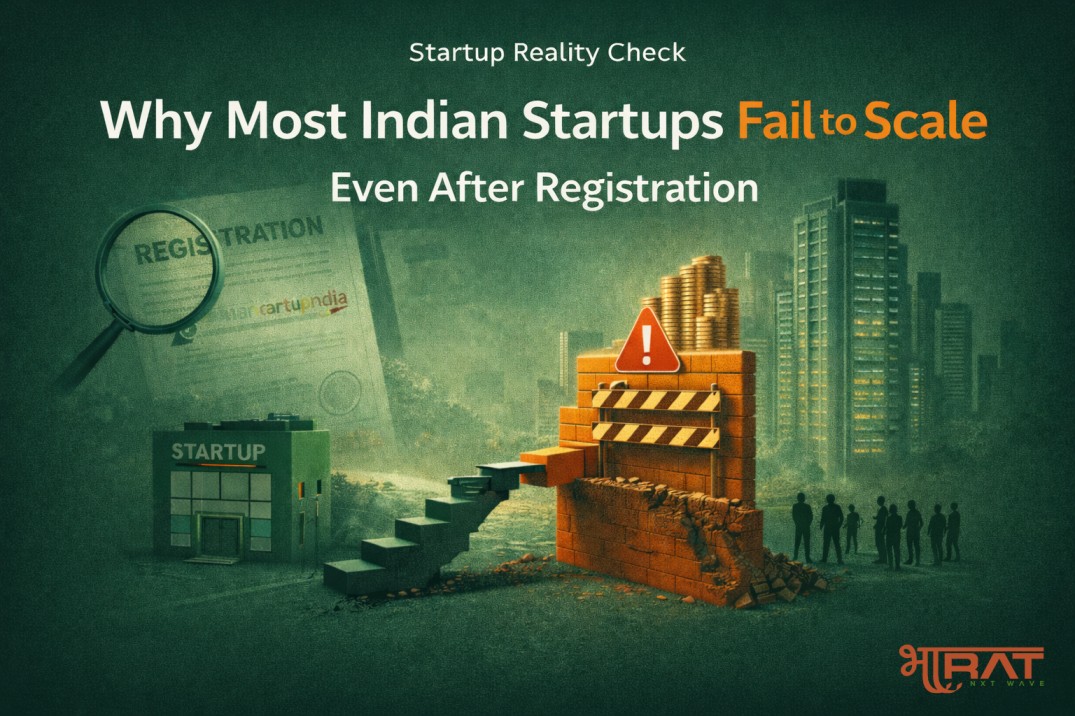
Every year, thousands of founders register companies under Startup India, incorporate private limited firms, and proudly announce their entrepreneurial journey. Yet, only a small percentage of these ventures actually grow into scalable, sustainable businesses. This gap raises a critical question: why Indian startups fail to scale even after completing formal registration and government recognition.
The reality is that registration is only the first step. Scaling requires structure, compliance readiness, financial discipline, funding preparedness, and strategic execution. Many founders assume that incorporation and a DPIIT certificate are enough to unlock growth. In practice, most startups struggle because they underestimate the operational and strategic demands of scale.
This blog explores the real reasons why Indian startups fail to scale, drawing from ecosystem insights, Startup India trends, and practical founder mistakes. More importantly, it outlines what founders must do differently to move from registration to real growth.
For many founders, company registration feels like a milestone that guarantees momentum. Incorporation brings legitimacy, a PAN number, a bank account, and sometimes a sense of institutional validation. But this milestone often creates a dangerous illusion — that the hardest part is over.
In reality, registration only formalizes the business; it does not prepare it for scale. One of the primary reasons why Indian startups fail to scale is the lack of a post-registration roadmap.
Without clarity on compliance, funding readiness, governance, and operational processes, startups stagnate even after formal recognition.
A scalable startup is built on a robust business model. Unfortunately, many registered startups operate with:
When growth depends purely on assumptions rather than data, scale becomes impossible. This structural weakness is a major contributor to why Indian startups fail to scale.
Investors and lenders today evaluate business sustainability, not just innovation. Founders who cannot articulate how revenue grows with scale struggle to secure funding and partnerships.
As startups grow, regulatory compliance becomes a non-negotiable requirement. Yet, compliance is one of the most ignored aspects of early-stage entrepreneurship.
Common compliance gaps include:
Non-compliance blocks funding, delays government scheme approvals, and erodes institutional trust. This operational weakness is another key reason why Indian startups fail to scale.
The Ministry of Corporate Affairs governs corporate compliance in India, and founders must align with its frameworks to maintain regulatory credibility. Official compliance guidelines are available at: https://www.mca.gov.in
One of the most common misconceptions among founders is that funding is guaranteed once a startup is registered or recognized under Startup India.
In reality, most startups are not funding-ready.
Investors and government schemes evaluate:
Startups that lack these elements face repeated rejections. This funding-readiness gap explains why Indian startups fail to scale even after DPIIT recognition.
Professional advisory plays a critical role in closing this gap. BharatNXT Wave supports startups with funding readiness, compliance alignment, and documentation structuring, helping founders build investor-ready businesses. You can explore funding advisory services here: https://bharatnxtwave.com/services/msme-loans/
DPIIT recognition and Startup India certificates offer significant benefits, but they are not growth guarantees.
Many founders treat recognition as an endpoint rather than a starting point. While government recognition improves credibility, growth still depends on execution, strategy, and financial discipline.
The official Startup India portal outlines recognition benefits and scheme access: https://www.startupindia.gov.in
Yet, without internal operational readiness, recognition alone cannot solve scale challenges. This misplaced reliance contributes to why Indian startups fail to scale.
Many startups qualify as MSMEs but fail to leverage MSME registration strategically.
Common mistakes include:
Proper MSME registration unlocks credit guarantees, priority sector lending, and interest subsidies. Ignoring this framework limits capital access and contributes to why Indian startups fail to scale.
The official MSME portal governs registration and benefits: https://msme.gov.in
Cash flow mismanagement is one of the fastest ways to kill a startup.
Many registered startups fail because they:
Without financial discipline, startups burn capital without building sustainable revenue. This operational failure is a fundamental reason why Indian startups fail to scale.
Scaling requires partnerships, funding, and ecosystem integration. Yet, many startups fail to build institutional trust.
Trust gaps emerge due to:
Banks, investors, and government bodies increasingly prioritize credibility over ambition. Startups that neglect trust-building mechanisms struggle to scale.
Technology adoption is now a baseline requirement for scalability.
Yet, many startups still operate with:
Digital transformation improves:
Startups that fail to adopt digital systems fall behind competitors and face scalability bottlenecks.
Professional advisory is no longer optional for growth-stage startups.
From compliance and certification to funding readiness and strategic execution, expert guidance reduces founder risk and increases growth velocity.
BharatNXT Wave supports startups with registration, compliance, MSME certification, and funding advisory, helping founders move beyond survival into scale. Learn more about advisory services here: https://bharatnxtwave.com/services/
To summarize, the most common reasons why Indian startups fail to scale include:
These failures are not about lack of ideas. They are about lack of structure.
To avoid becoming part of the scale-failure statistic, founders must:
Growth is not accidental. It is engineered.
As Startup India enters its second decade, the ecosystem will increasingly reward founders who are:
The era of informal experimentation is ending. Structured execution is the new growth strategy.
The reality is simple: registration does not equal scalability.
Understanding why Indian startups fail to scale reveals that the real challenge lies in execution discipline, financial readiness, compliance alignment, and strategic planning.
Founders who treat registration as the beginning — not the finish line — gain a decisive advantage.
With the right advisory support, governance frameworks, and growth mindset, Indian startups can move beyond survival into sustainable scale.
Scale is not built on ambition alone. It is built on structure.