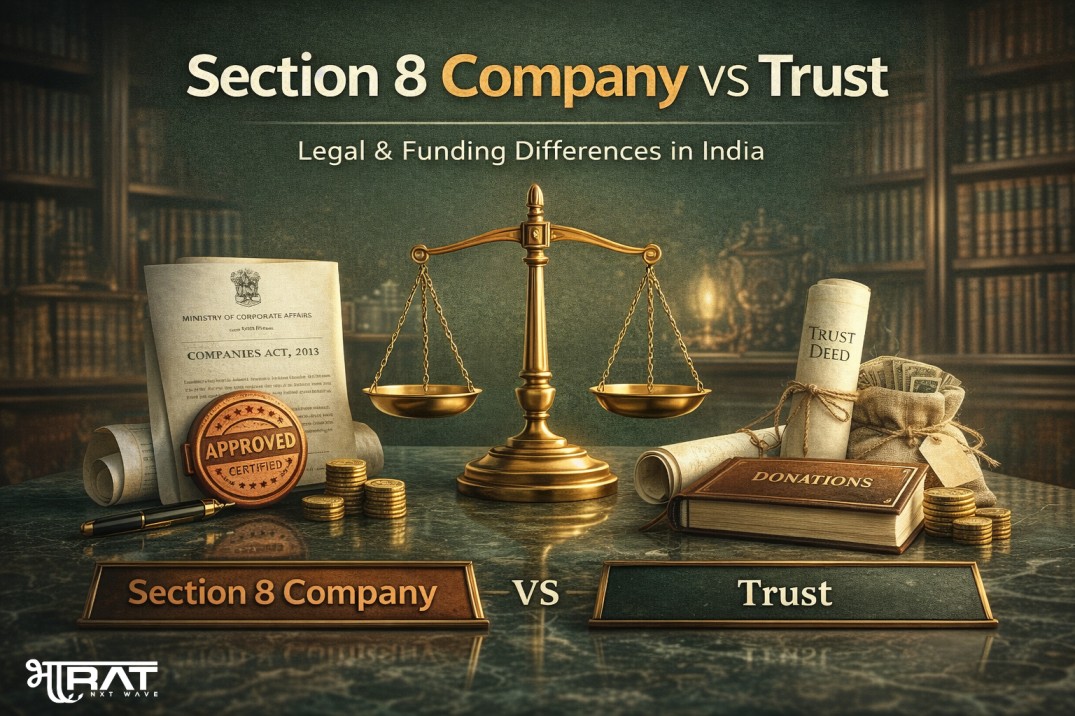
Choosing the right legal structure is one of the most critical decisions for any mission-driven organization in India. Whether you are planning to run a non-profit initiative, seek government grants, attract CSR funding, or build long-term institutional credibility, the debate around Section 8 Company vs Trust in India cannot be ignored.
Many founders make the mistake of selecting a structure based on convenience or advice from peers, without fully understanding the long-term legal, compliance, and funding consequences. In 2026, regulatory scrutiny, donor expectations, and funding mechanisms have evolved significantly. What worked a decade ago may now limit your organization’s growth, credibility, and access to funds.
This detailed guide breaks down Section 8 Company vs Trust in India from a practical, legal, and funding perspective—so you can make an informed decision aligned with your mission, scale, and compliance strategy.
Before comparing funding and compliance implications, it’s essential to understand what each structure actually represents under Indian law.
A Section 8 Company is a non-profit organization registered under the Companies Act, 2013. It is formed with the objective of promoting charitable purposes such as education, social welfare, environmental protection, healthcare, research, and similar causes.
In the Section 8 Company vs Trust in India comparison, Section 8 companies are known for:
Strong governance
High transparency
Corporate-style compliance
Better credibility with institutional funders
Importantly, profits earned by a Section 8 Company must be reinvested in achieving its objectives and cannot be distributed as dividends.
A Trust is governed by the Indian Trusts Act, 1882 (for private trusts) or relevant state trust laws (for public charitable trusts). It is created by a trust deed and managed by trustees.
In the Section 8 Company vs Trust in India debate, trusts are often chosen because:
They are easier to form
They involve fewer initial compliances
They offer flexibility in internal management
However, this flexibility often comes at the cost of weaker governance structures.
A major distinction in Section 8 Company vs Trust in India lies in the governing authority.
Section 8 Companies are regulated by the Ministry of Corporate Affairs (MCA)
Trusts are regulated by state-level authorities
This difference directly affects transparency, enforcement, and regulatory oversight.
Governance is where Section 8 Company vs Trust in India shows a sharp contrast.
Section 8 Companies:
Have a Board of Directors
Follow structured decision-making
Require board resolutions and disclosures
Trusts:
Are governed by trustees
Often lack formal accountability mechanisms
Depend heavily on individual trustee integrity
For long-term sustainability, governance clarity matters more than ease of formation.
One common myth in the Section 8 Company vs Trust in India discussion is that lower compliance is always better.
Section 8 Companies must comply with:
Annual ROC filings
Board meetings
Financial audits
Statutory disclosures
While this seems heavy, it creates institutional trust, which directly impacts funding opportunities.
Trusts usually have:
Fewer statutory filings
Less structured reporting
Lower visibility to regulators
However, this lack of structure often raises red flags for banks, CSR donors, and international funding agencies.
Funding is the most decisive factor in choosing between a Section 8 Company and a Trust.
Government departments increasingly prefer entities with transparent governance. In the Section 8 Company vs Trust in India funding landscape, Section 8 Companies enjoy an advantage due to standardized reporting and compliance visibility.
To understand how legal structures impacts grant approvals, read our detailed guide on Government Grants for Startups and NGOs here: https://bharatnxtwave.com/government-grants-for-startup
CSR donors are governed by strict compliance obligations under the Companies Act. This tilts the balance in favor of Section 8 Companies in the Section 8 Company vs Trust in India comparison.
As per the Ministry of Corporate Affairs CSR framework, CSR funds are closely linked to compliance transparency (Source: https://www.mca.gov.in).
When evaluating Section 8 Company vs Trust in India for foreign contributions, both structures can apply for FCRA registration. However, Section 8 Companies are often viewed as more reliable due to documented governance practices.
You can review official FCRA eligibility guidelines on the Ministry of Home Affairs website: https://fcraonline.nic.in
Both Section 8 Companies and Trusts can apply for:
12A tax exemption
80G donor deduction benefits
However, approval timelines and scrutiny levels differ significantly in the Section 8 Company vs Trust in India comparison.
Learn how proper registration improves approval chances in our article on Tax Exemptions for NGOs and Section 8 Companies: https://bharatnxtwave.com/tax-exemption-certificate
Banks and financial institutions assess:
Governance structure
Documentation discipline
Regulatory visibility
In the Section 8 Company vs Trust in India debate, Section 8 Companies typically score higher due to MCA oversight and standardized disclosures.
RBI’s emphasis on governance and transparency for institutional lending can be explored here: https://www.rbi.org.in
A Trust may be suitable if:
The initiative is small and localized
Funding needs are limited
Founder control is a priority
However, growth limitations become evident over time.
In most modern scenarios, Section 8 Company vs Trust in India favors Section 8 Companies for organizations aiming to:
Scale nationally
Partner with corporates
Attract institutional funding
Build long-term credibility
The right legal structure depends on factors such as funding goals, tax exemptions, regulatory oversight, and long-term expansion plans.
One of the biggest mistakes in the Section 8 Company vs Trust in India decision is prioritizing short-term convenience over long-term sustainability.
Common errors include:
Choosing a Trust just to avoid compliance
Ignoring funding roadmap
Underestimating donor expectations
Delaying professional structuring
These mistakes often result in restructuring costs later.
If your vision is impact + scale + funding + credibility, the answer is clear.
Section 8 Company vs Trust in India is no longer just a legal choice—it is a strategic decision that defines your organization’s future.
Trusts = flexibility, limited scale
Section 8 Companies = credibility, funding readiness, long-term growth
In 2026, regulatory frameworks, funding agencies, and donors expect professionalism, transparency, and accountability. Choosing the right structure at the beginning saves years of operational friction.
The Section 8 Company vs Trust in India decision should be made with a clear understanding of legal obligations, funding goals, and long-term vision—not shortcuts.
If you plan to build an organization that lasts, attracts funding, and earns institutional trust, structure is not paperwork—it is strategy.