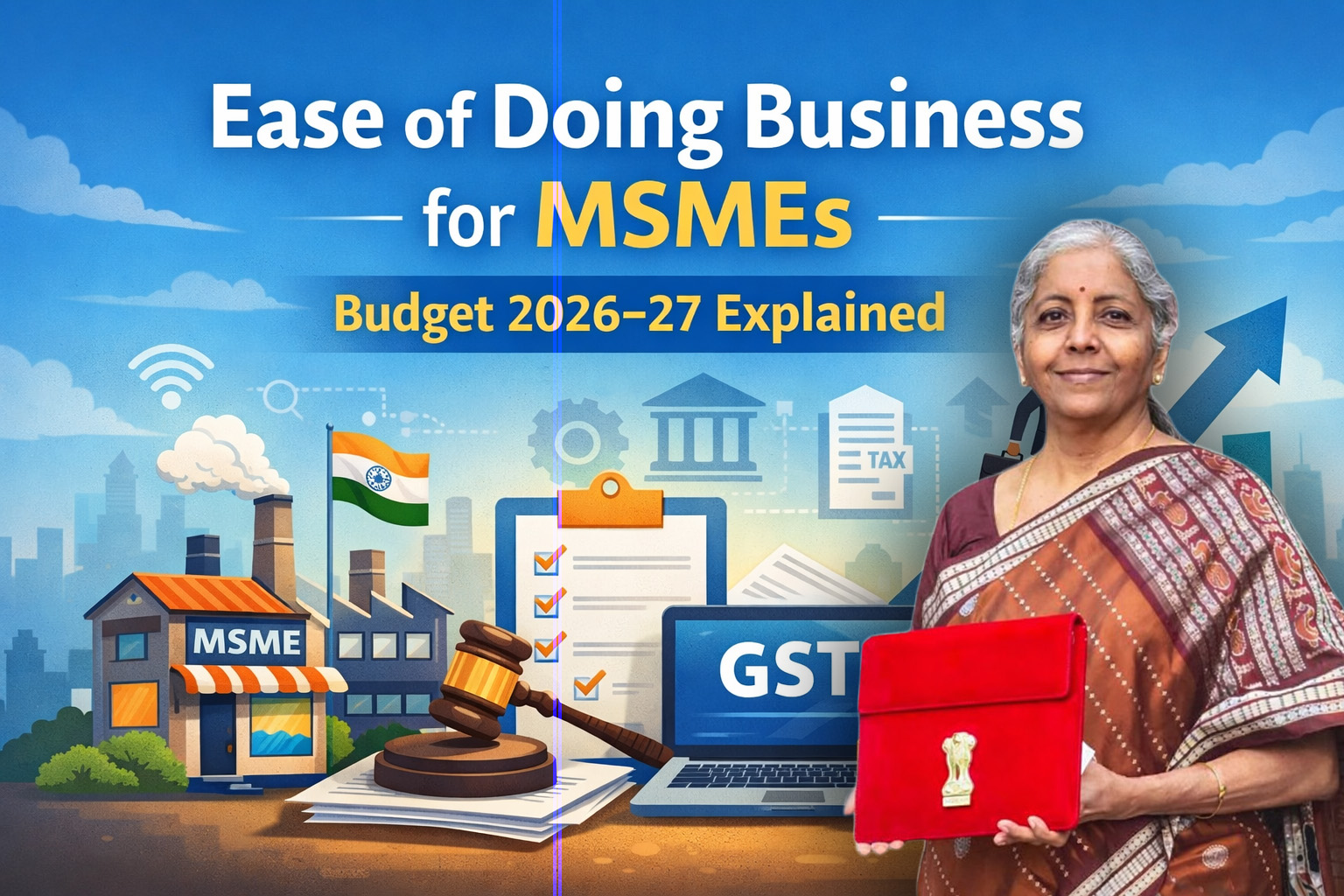
The Ease of Doing Business for MSMEs has emerged as a central theme in India’s economic reform journey, and the Union Budget 2026–27 marks a decisive step in that direction. Micro, Small, and Medium Enterprises (MSMEs) form the backbone of the Indian economy, contributing significantly to employment generation, GDP growth, and exports. However, for years, regulatory complexity, multiple compliances, and procedural delays have hampered MSME growth and discouraged entrepreneurship.
With Budget 2026–27, the Government of India has introduced a new wave of reforms aimed at reducing the compliance burden, improving digital governance, and enhancing the overall ease of doing business for MSMEs. These measures are designed not only to simplify operations for existing enterprises but also to encourage new startups and informal businesses to enter the formal economy.
This blog explores how Budget 2026–27 strengthens the ease of doing business for MSMEs, analyzes key compliance reforms, and explains why these changes are crucial for India’s long-term economic competitiveness in a globalized world.
The concept of Ease of Doing Business for MSMEs refers to how simple it is for small and medium businesses to start, operate, and expand without facing excessive regulatory hurdles. In India, MSMEs often deal with overlapping laws related to taxation, labor, environmental compliance, and financial reporting, which increases operational costs and reduces productivity.
Budget 2026–27 recognizes that improving ease of doing business for MSMEs is not just about reducing paperwork but also about creating a predictable and transparent policy environment. By focusing on compliance simplification and digital integration, the government aims to align MSME operations with modern business practices while supporting inclusive economic growth.
Globally, ease of doing business indicators influence investor confidence, export competitiveness, and entrepreneurship rates. Therefore, reforms targeting MSMEs also help India improve its position in global competitiveness rankings and strengthen the startup ecosystem.
One of the biggest obstacles to the Ease of Doing Business for MSMEs has been the heavy compliance burden. Small businesses often lack dedicated legal or accounting teams, making it difficult to keep up with frequent regulatory changes under GST, income tax, labor laws, and sector-specific regulations.
Budget 2026–27 addresses this long-standing issue by acknowledging that excessive compliance discourages formalization and innovation. Many MSMEs prefer to remain informal due to fear of penalties, inspections, and administrative complexity. This not only limits their access to credit and government schemes but also affects overall economic transparency.
By reducing compliance requirements and promoting trust-based governance, the government aims to shift from a control-oriented approach to a facilitative regulatory framework that genuinely supports MSME growth.
The Union Budget 2026–27 introduces a reform agenda that directly targets the Ease of Doing Business for MSMEs through structural, procedural, and digital initiatives. Instead of isolated announcements, the budget presents a comprehensive compliance reform strategy.
Key objectives outlined in Budget 2026–27 include:
Rationalization of regulatory filings
Expansion of digital compliance platforms
Reduction in physical inspections
Simplification of tax and labor law compliance
These reforms align with broader government initiatives such as Digital India, Startup India, and Atmanirbhar Bharat, creating a unified ecosystem for MSMEs.
One of the most impactful steps toward improving the Ease of Doing Business for MSMEs is the reduction in the number of mandatory filings. Budget 2026–27 proposes consolidated annual returns for small businesses, replacing multiple periodic filings across departments.
This move significantly lowers compliance costs, reduces the need for intermediaries, and minimizes errors that often lead to penalties. Simplified filing systems also help MSMEs focus more on business operations and less on administrative formalities.
By integrating compliance under a single digital interface, the government strengthens transparency while making regulatory adherence less intimidating for entrepreneurs.
Digital governance plays a crucial role in enhancing the Ease of Doing Business for MSMEs. Budget 2026–27 expands the use of AI-enabled compliance portals that offer automated reminders, pre-filled forms, and real-time validation.
These digital reforms reduce human intervention, thereby minimizing corruption and delays. MSMEs operating in remote or semi-urban areas benefit the most, as digital platforms eliminate the need for physical office visits and lengthy approval processes.
The emphasis on digital compliance also aligns with global best practices and enhances India’s reputation as a technology-driven economy.
GST compliance has been a critical factor affecting the Ease of Doing Business for MSMEs. Budget 2026–27 introduces further GST rationalization, including simplified return structures and extended filing timelines for small taxpayers.
The government has also announced reduced penalties for minor procedural lapses, signaling a shift toward a supportive rather than punitive tax environment. These measures encourage voluntary compliance and reduce litigation risks for MSMEs.
By making GST simpler and more predictable, Budget 2026–27 strengthens MSME participation in the formal economy.
Income tax reforms announced in Budget 2026–27 further enhance the Ease of Doing Business for MSMEs. Increased thresholds for presumptive taxation and simplified audit requirements reduce the compliance burden for small enterprises.
These reforms improve cash flow management and allow MSMEs to reinvest profits into expansion, innovation, and job creation. A stable and simplified tax regime also boosts investor confidence and promotes long-term business planning.
Labor compliance has historically been complex, directly impacting the Ease of Doing Business for MSMEs. Budget 2026–27 builds on earlier labor code reforms by streamlining registration, reporting, and inspection mechanisms.
The introduction of unified labor compliance portals reduces duplication and ensures consistency across states. MSMEs benefit from fewer inspections and clearer guidelines, enabling them to focus on workforce productivity rather than regulatory fear.
These reforms strike a balance between worker protection and business flexibility, which is essential for sustainable MSME growth.
Budget 2026–27 emphasizes trust-based governance as a key pillar of the Ease of Doing Business for MSMEs. Randomized inspections, self-certification mechanisms, and risk-based scrutiny replace routine physical checks.
This approach reduces harassment and builds confidence among entrepreneurs. When businesses feel trusted, compliance improves organically, leading to higher formalization rates and better economic data.
Trust-based governance also aligns India with global regulatory standards, improving its attractiveness to foreign investors and trade partners.
While compliance simplification is crucial, access to finance also influences the Ease of Doing Business for MSMEs. Budget 2026–27 strengthens credit guarantee schemes and integrates compliance data with lending platforms.
Digitally verified compliance records help banks assess MSME creditworthiness more efficiently. This reduces approval timelines and enhances financial inclusion for small businesses.
Improved access to affordable credit allows MSMEs to scale operations, invest in technology, and compete in domestic and international markets.
The reforms introduced in Budget 2026–27 significantly improve the Ease of Doing Business for MSMEs, especially for startups and first-time entrepreneurs. Simplified registration, reduced compliance costs, and digital onboarding lower entry barriers.
A friendlier regulatory environment encourages innovation and risk-taking, which are essential for a vibrant startup ecosystem. These changes also support India’s ambition to become a global startup hub.
Improving the Ease of Doing Business for MSMEs has direct implications for India’s global competitiveness. Simplified compliance enables MSMEs to integrate into global value chains and meet international standards.
Export-oriented MSMEs benefit from faster clearances, predictable regulations, and improved access to trade facilitation schemes. This strengthens India’s position in global trade and supports economic resilience.
The long-term impact of enhanced Ease of Doing Business for MSMEs extends beyond individual enterprises. Reduced compliance costs improve productivity, create jobs, and increase tax revenues through higher voluntary compliance.
A simplified regulatory environment also supports sustainable development by encouraging formalization and accountability. Budget 2026–27 lays the foundation for a more inclusive and efficient economic framework.
While Budget 2026–27 marks a significant step forward, achieving complete Ease of Doing Business for MSMEs requires effective implementation. Coordination between central and state governments, digital literacy, and grievance redressal mechanisms remain critical.
Continuous stakeholder engagement and periodic review of compliance frameworks will ensure that reforms deliver tangible benefits on the ground.
Budget 2026–27 represents a transformative moment for the Ease of Doing Business for MSMEs in India. By focusing on compliance simplification, digital governance, and trust-based regulation, the government has addressed long-standing structural challenges.
These reforms empower MSMEs to grow, innovate, and compete globally, reinforcing their role as the backbone of the Indian economy. If implemented effectively, Budget 2026–27 will not only reduce compliance burdens but also unlock the full potential of India’s entrepreneurial ecosystem.