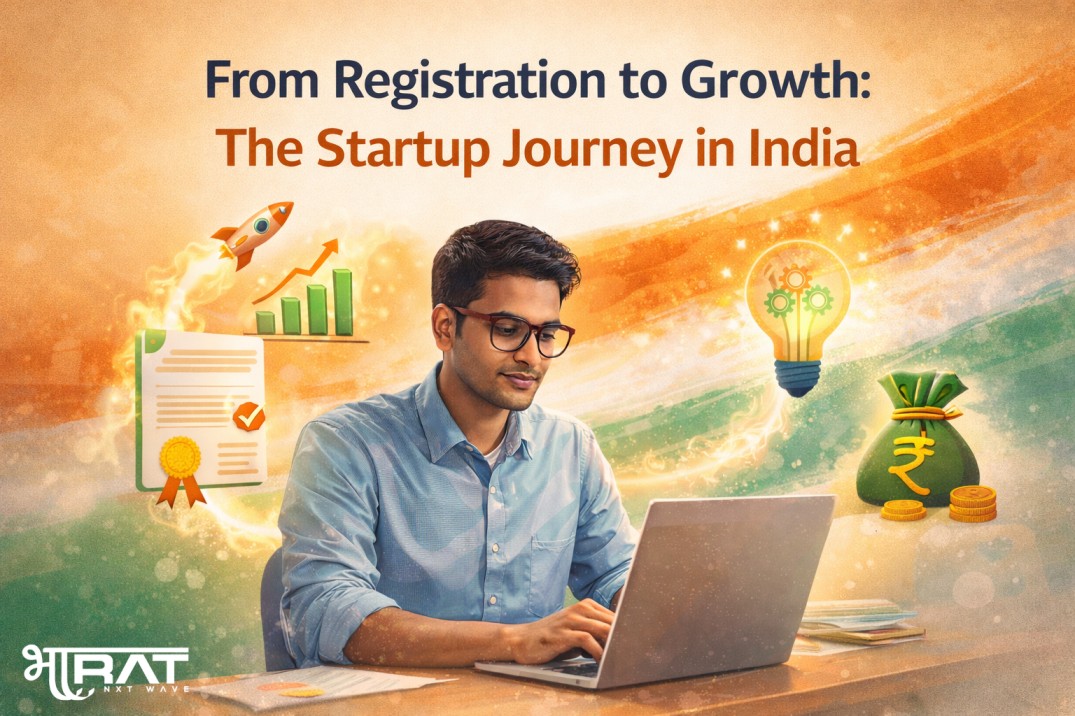
The startup journey in India has evolved into one of the most dynamic entrepreneurial stories in the world. From a time when registering a business involved months of paperwork and regulatory uncertainty, today’s founders operate within a structured ecosystem supported by digital processes, government schemes, funding programs, and policy reforms.
In the last decade, the startup journey in India has become more accessible to young entrepreneurs, MSME founders, women-led startups, and innovators from Tier 2 and Tier 3 cities. The Government of India’s Startup India initiative, DPIIT recognition, MSME registration frameworks, and funding schemes have transformed how startups move from idea to execution.
But while launching a company is easier than ever, building a sustainable and scalable business requires understanding every stage of the startup journey in India—from registration and compliance to funding readiness and long-term growth.
This blog explores the complete roadmap founders must follow to navigate the modern startup journey in India successfully.
Every startup journey in India begins with formal business registration. Choosing the right legal structure is a critical foundation that determines compliance requirements, tax treatment, funding eligibility, and investor credibility.
Types of Business Structures in India
Founders typically choose from:
For startups planning to raise funding, the Private Limited Company structure is usually the best choice.
Professional incorporation support can simplify this process significantly. BharatNXT Wave helps startups with company registration and incorporation services, ensuring founders start their startup journey in India with a legally sound foundation. You can explore registration support here: https://bharatnxtwave.com/services/
Once registered, the next milestone in the startup journey in India is obtaining DPIIT recognition under the Startup India initiative.
DPIIT-recognised startups gain access to:
Official recognition is handled through the Government of India’s Startup India portal: https://www.startupindia.gov.in
For founders, DPIIT certification is not just symbolic—it directly improves funding access and institutional trust.
Many startups also qualify as MSMEs under India’s classification framework. MSME registration (Udyam Registration) plays a crucial role in strengthening the startup journey in India.
The Ministry of MSME governs the official MSME framework: https://msme.gov.in
Structured MSME registration improves a startup’s financial credibility and loan eligibility.
As startups grow, compliance becomes a central pillar of the startup journey in India. Investors, banks, and government agencies now prioritise governance, transparency, and regulatory readiness. Key Compliance Requirements
Non-compliance can delay funding, block government benefits, and weaken institutional trust.
The Ministry of Corporate Affairs governs corporate compliance frameworks: https://www.mca.gov.in
This is why compliance advisory is now an essential service for founders navigating the startup journey in India.
Government schemes are among the strongest enablers of the modern startup journey in India.
However, most startups fail to access these schemes due to documentation gaps, compliance issues, and proposal weaknesses.
BharatNXT Wave supports startups with funding advisory and scheme readiness services, helping founders unlock government funding opportunities. Learn more here: https://bharatnxtwave.com/services/msme-loans/
Raising capital is a defining milestone in the startup journey in India.
But funding is not just about pitching. Investors now evaluate:
Founders who prepare structured documentation and pitch decks improve their funding success dramatically.
Technology adoption has become a cornerstone of the startup journey in India.
Startups today rely on:
For MSMEs, digital transformation improves:
Startups that adopt digital tools early scale faster and remain competitive within the Indian startup ecosystem.
Trust is emerging as a defining currency in the modern startup journey in India.
Banks, investors, and government bodies now prioritise:
Startups that invest early in trust-building systems gain faster approvals, easier funding access, and stronger partnerships.
True success in the startup journey in India lies beyond incorporation.
Startups that focus on execution discipline outperform those that only chase valuations.
Professional advisory has become an essential growth accelerator in the startup journey in India.
From compliance and certification to funding readiness and strategic execution, expert guidance reduces founder risk and increases growth velocity.
BharatNXT Wave supports startups across every phase of their journey, from registration to scale, ensuring founders build strong, future-ready businesses. Explore advisory services here: https://bharatnxtwave.com/services/msme-registration/
Despite ecosystem improvements, startups still face critical challenges:
Addressing these issues early determines long-term survival and success.
As Startup India enters its second decade, the startup journey in India will increasingly reward founders who are:
The era of informal experimentation is giving way to structured execution.
The modern startup journey in India is no longer just about launching ideas—it is about building resilient, compliant, and scalable enterprises.
From business registration and DPIIT recognition to MSME certification, compliance, funding readiness, and strategic growth, every stage matters.
Founders who approach the startup journey in India with structure, discipline, and professional guidance gain a decisive advantage.
With the right ecosystem support, advisory frameworks, and growth mindset, the startup journey in India is poised to create the next generation of global Indian enterprises.
The future belongs to founders who prepare today, not those who wait for tomorrow.