In India’s evolving startup ecosystem, founders today have more funding options than ever before. From venture capital firms chasing high-growth startups to government-backed grants designed to support innovation and inclusive entrepreneurship, capital is available—but not without complexity.
One of the most misunderstood decisions founders face is choosing between VC funding vs government grants in India. While both provide capital, they impact ownership, control, compliance, growth strategy, and long-term sustainability in very different ways.
This blog presents a deep capital structure analysis of VC funding vs government grants in India, helping startups and MSMEs understand not just which option is available, but which option is strategically right for their stage, sector, and long-term vision.
Capital structure refers to how a business finances its operations and growth, typically through a mix of:
Equity
Debt
Non-dilutive capital (grants, subsidies)
In India, capital structure decisions are heavily influenced by:
Founder ownership sensitivity
Regulatory compliance
Sector-specific policies
Long gestation business models
When comparing VC funding vs government grants in India, founders must look beyond money and evaluate what they are giving up in return.
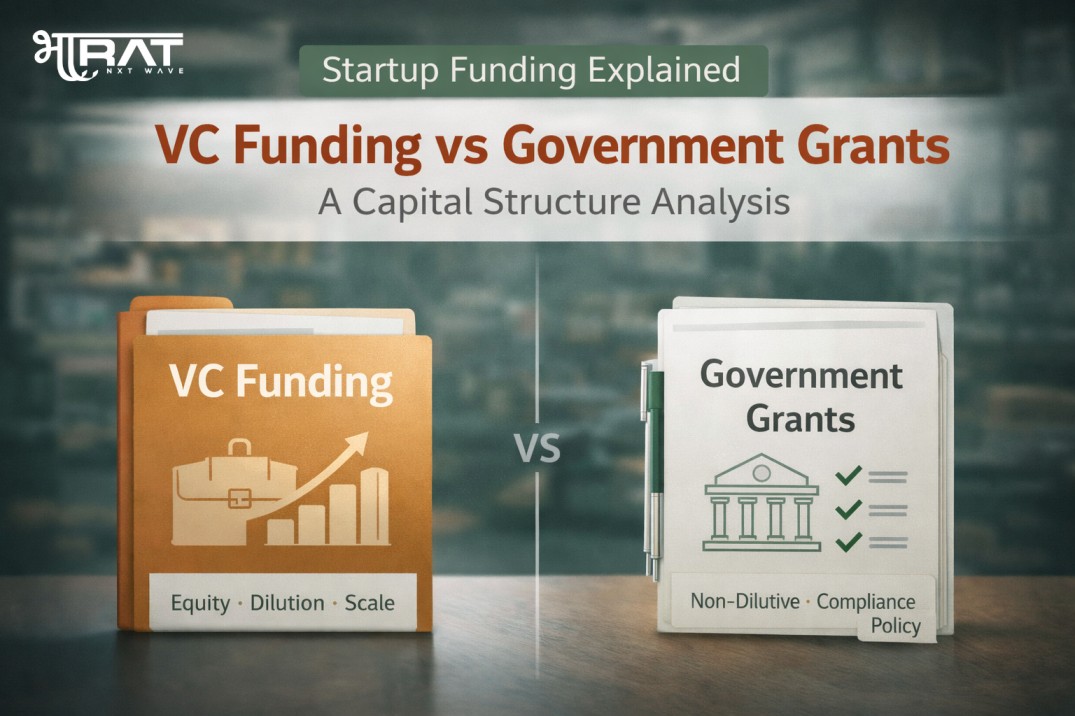
Venture Capital (VC) funding is equity-based financing provided by private investors or VC firms in exchange for ownership stakes in high-growth startups.
Dilution of founder equity
Investor board involvement
Growth and exit pressure
Valuation-based capital infusion
VC funding is designed for businesses that can:
Scale rapidly
Capture large markets
Deliver exponential returns
Government grants are non-dilutive financial support provided by central or state governments to encourage innovation, MSME growth, employment, and sectoral development.
Unlike VC funding, grants:
Do not require equity dilution
Are milestone and compliance driven
Focus on sustainability and impact
Government grants form a crucial part of India’s policy-driven startup support system.
All official grant applications and compliance filings are routed through the official government portals, which act as the primary source of verification for funding authorities and implementing agencies.
| Factor | VC Funding | Government Grants |
|---|---|---|
| Nature of Capital | Equity-based | Non-dilutive |
| Ownership Impact | Dilution required | No dilution |
| Control | Shared with investors | Retained by founders |
| Risk | High-growth, high-pressure | Compliance-driven |
| Exit Expectation | Mandatory | None |
This contrast lies at the heart of VC funding vs government grants in India.
VC funding permanently alters the ownership structure. Each funding round reduces founder equity.
Investors gain:
Board seats
Veto rights
Strategic influence
VC-backed startups must follow strict financial transparency and reporting norms.
Founders retain full ownership.
Funds must be used strictly for approved purposes.
Grant utilization is audited periodically.
Institutions like SIDBI emphasize structured fund utilization and compliance under the SIDBI startup and MSME support framework, ensuring grants translate into sustainable growth rather than speculative expansion.
Best fit: Government grants
Reason: Limited traction, high uncertainty, founder ownership protection.
Best fit: VC funding
Reason: Market validation, scalability, faster expansion.
Best fit: Government grants + loans
Reason: Stability over hyper-growth.
This makes VC funding vs government grants in India a stage-dependent decision, not a one-size-fits-all choice.
Forced scaling
Misaligned vision
Exit pressure
Founder burnout
Delayed disbursement
Rigid milestones
Compliance penalties
A balanced capital structure minimizes these risks.
According to RBI lending and funding guidelines, equity and grant-based capital are treated differently in risk assessment and balance sheet evaluation, influencing future borrowing capacity.
This makes government grants particularly valuable for startups planning future debt or MSME loans.
SaaS
FinTech
Consumer tech
AI & platforms
AgriTech
HealthTech
Clean energy
Manufacturing
Social impact startups
Understanding this alignment is critical when evaluating VC funding vs government grants in India.
Many successful startups adopt a hybrid model, using:
Government grants for R&D and validation
VC funding for scaling
This preserves equity while enabling growth.
At BharatNXT Wave, our startup and MSME consulting services help founders design hybrid capital structures aligned with funding eligibility, compliance readiness, and long-term scalability.
1️⃣ Startup funding advisory
Founders often benefit from professional startup funding advisory to evaluate whether VC funding or government grants align better with their capital structure goals.
2️⃣ Government grant consulting service
Navigating eligibility, documentation, and compliance becomes easier with expert government grant consulting services focused on Indian startup policies.
3️⃣ MSME financial planning services
A robust capital structure requires disciplined forecasting, which is why MSME financial planning services play a crucial role in funding strategy.
1️⃣ Government of India Startup Portal
Policy-backed grants and eligibility frameworks are published through the official Startup India portal, which acts as the central reference point for founders.
2️⃣ RBI
As outlined in RBI regulatory publications, capital structure influences credit risk and borrowing potential.
3️⃣ SIDBI
Institutions like SIDBI provide structured funding under the SIDBI innovation and MSME financing framework, balancing capital access with accountability.
VC funding increases valuation expectations, while government grants strengthen balance sheets without inflating valuation prematurely.
This difference is often underestimated in VC funding vs government grants in India comparisons.
VC funding introduces external pressure and decision-sharing.
Government grants preserve founder autonomy but demand discipline.
The right choice depends on leadership style and vision.
Choosing VC too early
Ignoring grant eligibility
Mixing funds improperly
Underestimating compliance
Avoiding these mistakes is key to sustainable growth.
India’s startup ecosystem is moving toward:
More non-dilutive funding
Policy-led innovation
Blended finance models
This makes understanding VC funding vs government grants in India more important than ever.
Choosing between VC funding and government grants is not a financial decision alone—it is a strategic capital structure decision.
VC funding accelerates growth but reshapes control.
Government grants preserve ownership but demand discipline.
The smartest founders don’t choose one blindly—they design capital structures intentionally.
At BharatNXT Wave, we help startups and MSMEs make funding decisions that support not just growth, but long-term business resilience.