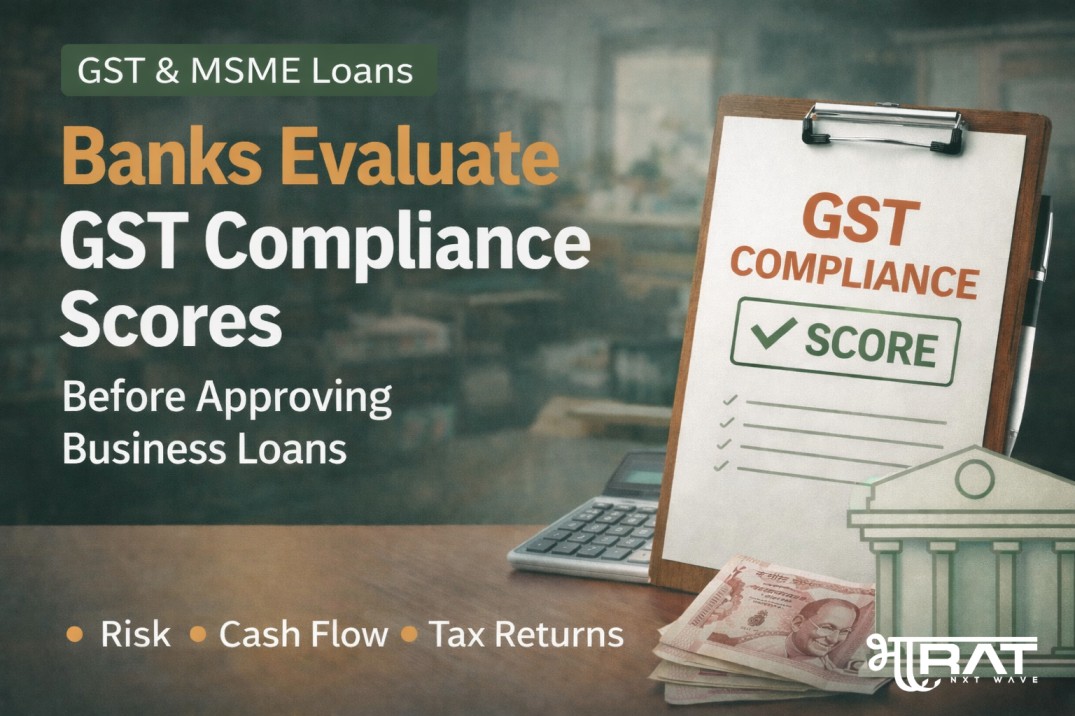
In India’s rapidly evolving financial ecosystem, entrepreneurs and MSMEs often focus heavily on CIBIL scores, balance sheets, and profit figures when applying for business loans. However, there is another powerful but largely invisible metric that banks and financial institutions quietly evaluate before approving credit—GST compliance score in India.
While there is no officially published numeric “GST score” shown to businesses, banks internally assess GST compliance behavior using return filings, payment discipline, and data consistency. For startups and MSMEs, this internal compliance assessment can make or break loan approvals, credit limits, and even interest rates.
As the Indian startup ecosystem matures and MSMEs become more digitally connected, GST compliance score in India has emerged as a silent trust indicator. This blog explains what it really means, how banks use it, why it matters more than ever in 2025, and how businesses can improve it to unlock funding opportunities.
The GST compliance score in India is not a single number displayed on the GST portal. Instead, it is an internal assessment framework used by banks, NBFCs, and government-backed financial institutions to evaluate how compliant a business is with GST regulations.
This assessment is derived from data available on the official GST portal, including:
Timeliness of GST return filings
Accuracy of reported turnover
Consistency between GSTR-1 and GSTR-3B
Tax payment discipline
History of notices, defaults, or mismatches
Banks increasingly rely on this data because GST filings reflect real-time business performance, unlike traditional financial statements that may lag behind.
In simple terms, GST compliance score in India reflects how trustworthy, transparent, and financially disciplined a business appears on paper.
All GST returns, filings, and compliance data considered by banks are sourced directly from the official GST portal, making accuracy and consistency critical for businesses.
Banks are no longer dependent solely on collateral or balance sheets. With digitization, lenders now assess businesses using data-backed risk profiling.
Here’s why GST compliance score in India matters so much to banks:
GST returns show actual sales, purchases, and tax payments, giving banks a realistic picture of cash flow.
Consistent GST compliance reduces the risk of inflated turnover or fake invoicing.
Regular and accurate filings indicate financial discipline, which banks associate with lower default risk.
Strong GST compliance often leads to quicker approvals under various MSME loan schemes in India, as less manual verification is required.
A strong GST compliance score in India significantly improves eligibility under various MSME loan schemes in India, as banks rely on GST data to assess real business turnover and repayment capacity.
According to RBI lending guidelines, banks increasingly rely on digital financial data such as GST returns to assess the creditworthiness of MSMEs.
Many business owners assume that CIBIL is the only score banks check. In reality, GST compliance score in India complements the CIBIL score rather than replacing it.
| Aspect | CIBIL Score | GST Compliance Score in India |
|---|---|---|
| Focus | Credit repayment history | Tax compliance behavior |
| Data Source | Loans & credit cards | GST returns & filings |
| Applies To | Individuals & businesses | GST-registered businesses |
| Updates | Monthly | Monthly / quarterly |
| Importance | High | Increasingly critical |
In many MSME cases, banks may overlook a moderate CIBIL score if GST compliance is strong, especially for working capital loans.
Although banks don’t publish their scoring formula, their evaluation generally includes:
Late or skipped returns immediately reduce compliance confidence.
Mismatch between GSTR-1 and GSTR-3B signals reporting issues.
Delayed tax payments indicate cash flow stress.
Sudden spikes or drops in turnover raise red flags.
Frequent GST notices negatively impact internal scoring.
This internal assessment helps banks decide loan approval, credit limits, tenure, and interest rates.
Many MSMEs unintentionally harm their GST compliance score in India due to avoidable errors.
Even a few delayed filings can signal financial instability.
Claiming excess input tax credit raises compliance risks.
Mismatch between sales invoices and returns triggers alerts.
Unanswered notices create long-term compliance issues.
Frequent nil filings may raise doubts about business continuity.
In 2025, GST data plays a central role in:
MSME working capital loans
CGTMSE-backed loans
MUDRA and PMFME schemes
NBFC credit lines
Digital lending platforms
Banks use GST compliance score in India to:
Verify revenue claims
Assess repayment capacity
Decide collateral requirements
Determine interest rates
Businesses with strong compliance records often receive better loan terms and faster approvals.
Shows outward supplies and sales accuracy.
Reflects actual tax liability and payments.
Mismatch between these returns weakens trust.
GST return filing behavior and its effect on compliance score is one of the most critical parameters banks observe during loan evaluation.
Businesses struggling with late filings or mismatched returns should seek professional GST registration and compliance services to correct errors and rebuild their GST compliance score in India.
👉 https://bharatnxtwave.com/gst-certificate/
India’s GST ecosystem is fully digital. This means:
Banks access GST data electronically
Manual explanations carry less weight
Data inconsistencies are flagged automatically
Institutions like SIDBI emphasize GST-linked cash flow analysis under the SIDBI MSME financing framework, reinforcing the importance of maintaining a healthy GST compliance score in India.
Institutions like SIDBI emphasize GST-linked cash flow analysis under the SIDBI MSME financing framework, reinforcing the importance of maintaining a healthy GST compliance score in India.
Improving compliance is not complicated, but it requires discipline.
Even nil returns should never be delayed.
Ensure all invoices match reported returns.
Claim only eligible and verified credits.
Respond promptly to GST communications.
Businesses struggling with late filings or mismatched returns should seek professional GST registration and compliance services to correct errors and rebuild their GST compliance score in India.
A strong GST compliance score in India significantly improves eligibility under various MSME loan schemes in India, as banks rely on GST data to assess real business turnover and repayment capacity.
👉Best Government Schemes for Indian Startups & MSMEs in 2026 (Loans, Grants & Subsidies)
Startups applying for:
Seed funding
Venture debt
Government grants
are increasingly evaluated on GST compliance behavior. Investors and lenders view GST discipline as a proxy for operational maturity.
According to RBI lending guidelines, banks increasingly rely on digital financial data such as GST returns to assess the creditworthiness of MSMEs.
Key trends making GST compliance score in India critical:
Rise of data-driven lending
Expansion of digital MSME loans
Increased government oversight
Integration of GST data with financial systems
Simply put, GST compliance is no longer optional—it’s strategic.
At BharatNXT Wave, our startup and MSME consulting services help businesses align GST compliance, financial reporting, and funding readiness under one strategic framework.
We assist with:
GST registration and filings
Compliance correction
Loan-readiness audits
Funding documentation
This integrated approach ensures your GST data supports—not blocks—your growth plans.
The GST compliance score in India may be invisible, but its impact is undeniable. Banks, NBFCs, and financial institutions increasingly rely on GST behavior to determine who deserves credit and who poses risk.
For MSMEs and startups, maintaining strong GST compliance is no longer just about avoiding penalties—it is about unlocking funding, improving credibility, and enabling sustainable growth.
In an ecosystem where data speaks louder than promises, your GST compliance story tells lenders everything they need to know.
At BharatNXT Wave, our startup and MSME consulting services help businesses align GST compliance, financial reporting, and funding readiness under one strategic framework.
👉https://bharatnxtwave.com/gst-certificate/