For Students, Creators & First-Time Entrepreneurs Who Feel Lost
Got a great product idea? Built something at a hackathon that impressed your mentors? Or maybe you and your college buddies are already working on an app. That’s amazing.
But if you want to go from “project” to “real startup,” you need to turn your idea into a registered business — one that can raise funds, apply for grants, get incubated, or even participate in government schemes.
This blog is your guide to that journey. Plain language. No legal jargon. Just 7 steps to build something official.
You might be thinking: “Why do I need to register now? Can’t I wait until we’re bigger?”
Here’s what startup registration helps with:
So yes, if you’re serious, start right.
You need to decide how your startup is going to be structured. Most student startups go with:
In most cases, go for Pvt Ltd if you want long-term scale and investment.
Startup registration is now 100% digital. Here’s what it looks like:
You’ll also receive your PAN, TAN, and bank-ready documents.
You can do this via MCA portal or with expert help from BharatNXT Wave.
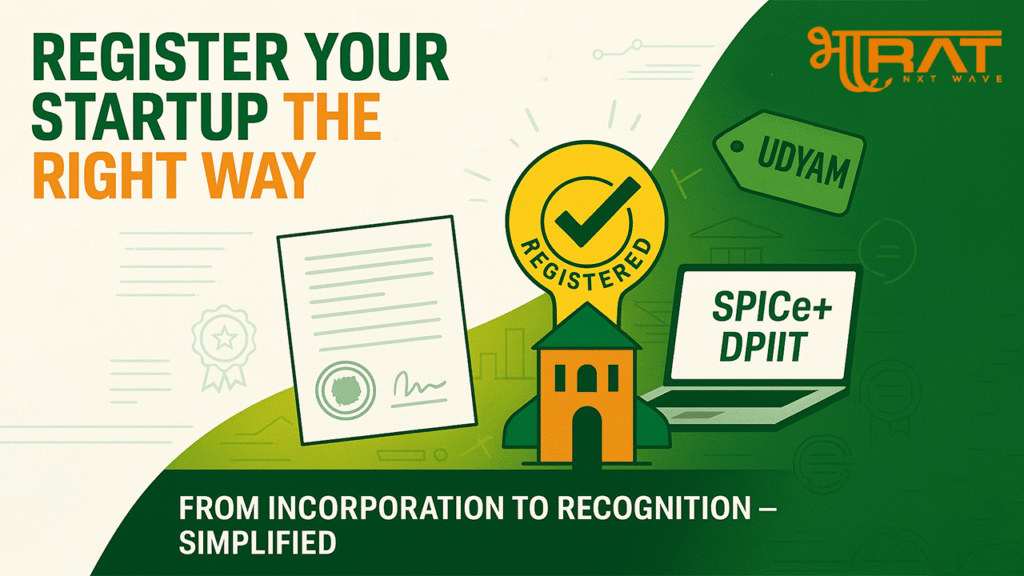
This is the official stamp that you’re a startup. DPIIT (Department for Promotion of Industry and Internal Trade) recognition gives you:
Who can apply?
Apply via Startup India Portal
Even student-led startups can register under Udyam (the MSME registration portal).
Why? Because it helps you:
It takes 10 minutes. You just need Aadhaar + PAN. Register here
Depending on what you build, you might need:
Many startups ignore this and run into issues later when applying for grants or building partnerships.
BharatNXT Wave can help you set up only what’s truly needed. No unnecessary paperwork.
Even before you approach an incubator or investor, you’ll need:
Need help? We offer pre-built templates + 1:1 sessions to get this sorted.
Most evaluators and mentors will Google you before anything else.
Make sure they find:
This doesn’t need to be perfect. It just needs to show: you’re real and building something.
❌ Waiting too long to register, then missing scheme deadlines
❌ Ignoring Udyam or DPIIT recognition early
❌ Trying to DIY everything and getting stuck in forms
❌ Using poor-quality pitch decks made last minute
❌ No digital presence = zero visibility = zero trust
Don’t repeat these. Use our checklist or connect with us to get it done right.
Q1. I just won a college hackathon. Should I register a company already?
Yes, if you want to turn that prototype into a real business. Registration opens doors to grants, incubation, and future investment.
Q2. I have no revenue yet. Can I still register my startup?
Absolutely. Startup registration (including DPIIT/Udyam) doesn’t require prior revenue. You just need an idea and clarity of execution.
Q3. Can I register a company while I’m still in college?
Yes. Many successful founders started during college. You can use your home address and register as a director legally at 18+.
Q4. What if I have co-founders? How is equity split handled?
We recommend a cap table and clear co-founder agreement. Equity split happens when the company is registered and we help structure it right.
Q5. Is it expensive to register a startup?
Basic incorporation costs are low and government fees are minimal for startups. We offer bundled packages that cover registration + DPIIT + Udyam.
Q6. What if I just want to test the idea first?
That’s fair. You can still start preparing the documents and basic branding, and register only when ready to raise funds or apply for schemes.
Q7. How long does registration usually take?
With expert help, you can be registered in 7–10 working days. DIY methods may delay you 2–3 weeks or more.
We specialize in helping student-led, early-stage startups build a fundable foundation:
We’ve helped startups from college dorms get recognised, funded, and incubated.
Startup dreams don’t wait. If your idea is ready, your startup should be too.
Turn your hackathon win, prototype, or MVP into a formal business that can raise funding, join an incubator, and scale.
You don’t have to do it alone.
📩 Connect with us to register your startup and start strong.