Built the Product? Now Register Your Startup Right
August 26, 2025
BharatNXT Wave
1. Get Your Foundation Right – Choose the Right Structure
Private Limited (Pvt Ltd): Ideal for raising funding, scalable growth, and credibility.
LLP: Great for small partnerships with limited liability.
Partnership / Sole Proprietorship: Simpler, but lacks formal recognition and scale potential.
Why it matters:
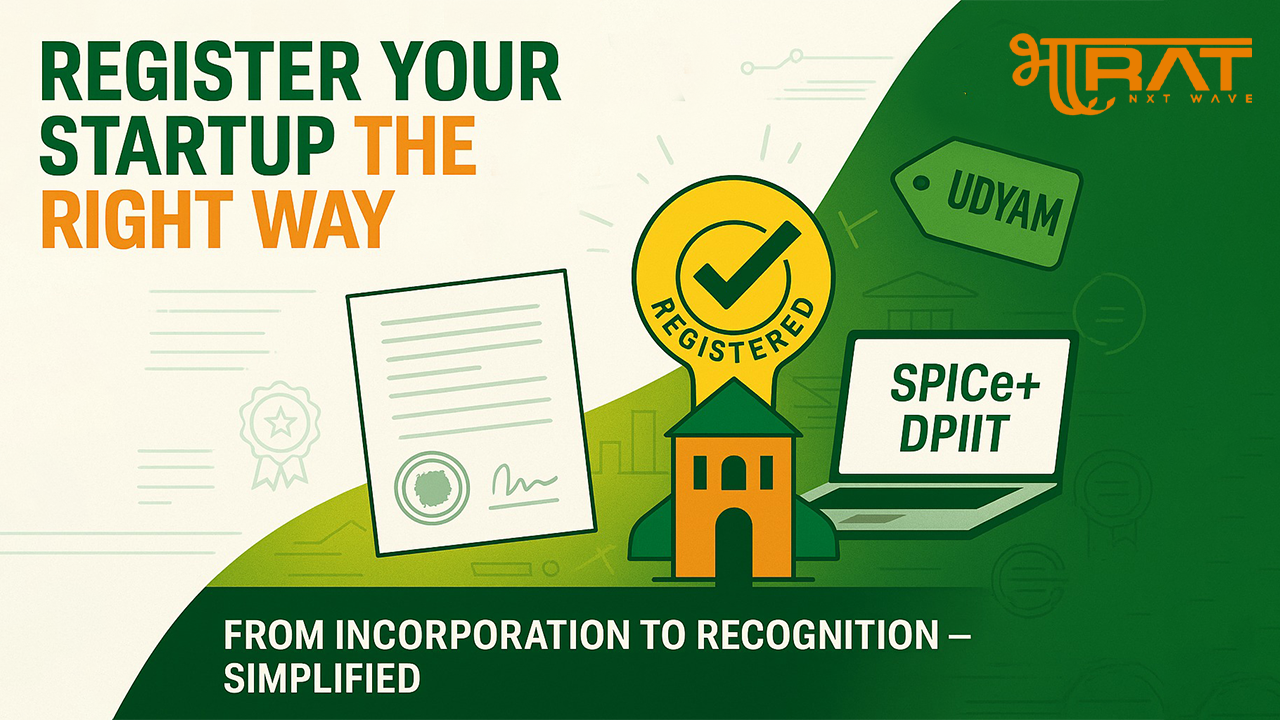
Investors and schemes like DPIIT Startup India only support Pvt Ltd or LLPs. According to Startup India, only these structures qualify for DPIIT recognition which gives tax exemptions, faster patent/applications and grants.
2. Incorporation Made Easy (No, You Don’t Need to DIY)
Full 5-minute walkthrough:
Obtain DSC & DIN for all directors.
Propose Company Name (RUN/SPICe+).
Submit INC-32 (SPICe+) with MOA/AOA, PAN, TAN, DSC, DIN, proof of address.
Once you get the Certificate of Incorporation, your startup exists legally everything else follows.
3. Register on the Startup India Portal + Get DPIIT Recognition
Sign up on NSWS or Startup India portal
Upload incorporation docs, pitch deck, director details, innovation summary.
DPIIT recognition chec
✅ Less than 10 years old
✅ Revenue < ₹100 Cr
✅ Structured as Pvt Ltd, LLP, or partnership module
Then claim benefits lik
3-year tax holiday under Section 80‑IAC
Angel tax exemption under Section 56
Priority for grants like Seed Fund, Atal, SAMRIDH
Priority procurement, IP fast track
4. Grab Your Udyam (MSME) Tag – It’s Not Just for Manufacturers
Vendor/Client Contracts – Even a simple service agreement protects your cashflow.
👉 Why it matters: Investors and grant committees look for “defensibility.” A company with clear IP ownership and contracts looks serious, investible, and less risky.
6. Get Funding Tools in Place: Grant, Loan, Equity-Friendly Docs
For Debt: balance sheets, Udyam status, bank statements
For Equity: financial models, projections, comparable analysis
An early investor once told us: “To be fundable, startups must look fundable.” This means clean legal structure + transparent financials + digital presence.
7. Polish Your Online Visibility – Investors do<> snoop online
Website: basic about, solution, team
LinkedIn & social: digital trail shows execution, testimonials, product live
Helps with grant evaluations and builds trust
8. Build Your Core Team & Advisory Layer Early
A company is more than paperwork – it’s people who execute the vision. Even in the earliest stage, founders who set up clarity on roles, ownership, and accountability tend to scale faster.
Founding Team Agreements: Write down who owns what (equity splits, responsibilities, vesting schedules). This avoids messy disputes later.
Advisory Board: Bring in 1–2 domain experts as advisors – they don’t need to be full-time, but their presence adds credibility for grants and investors.
ESOP Pool Setup: If you’re aiming to raise funds, earmark an Employee Stock Option Pool early. It signals seriousness to investors and helps you attract talent even if cash is tight.
Culture from Day 1: Whether it’s two people or twenty, set norms around communication, decision-making, and accountability. A bad culture can sink even the most fundable startups.
Why it matters: According to multiple startup case studies, investors back teams, not just ideas. Having a strong, structured team layer is as important as legal recognition. Plus, DPIIT-recognized startups get added brownie points when they show advisory depth and team clarity.
Continuous support so you can build, not chase forms
Final Word:
Registering your startup is only the start. The paperwork gives you wings, but your team and advisory structure are the engine that lets you fly. By getting incorporation, recognition, funding prep, AND a solid team layer right, you position yourself not just as a startup that exists but as one that’s built to last.
You shouldn’t have to suffer red tape to build something people love. Think of it as transforming from a “project” into a formal, recognized, fund-ready company with systems, support, and future clarity.